


Nutrient Imbalances Revealed As Trigger For Coral Diseases
As reported in the journal Nature Communications, researchers from the University of Southampton have discovered that an imbalance of nutrients in seawater can lead to coral disease—potentially more so than the heat stress caused by warming oceans. New studies carried out at Southampton’s Coral Reef Laboratory, in collaboration with colleagues from the University of Derby, indicate that disturbances in the delicate nutrient balance of the ocean can destabilise the microbial communities that coexist with corals, resulting in disease.
Devastating outbreaks include the prevalent and highly harmful Black Band Disease (BBD), which spreads across the coral surface, destroying coral tissue and leaving only bare skeleton behind.
While not the sole cause of BBD, the research team found that 88% of documented cases of the disease occurred in areas with significantly imbalanced seawater nutrient ratios.
Led by Associate Professor Cecilia D’Angelo from the University of Southampton, the research team showed that skewed ratios of seawater nutrients, such as an imbalance of nitrogen and phosphorus, disrupt the fragile microbial communities associated with corals. These microbes, both within and on the corals, are collectively referred to as the “coral microbiome.”
“When nutrients are out of balance, the interactions between members of the coral microbiome begin to break down,” says Dr. D’Angelo. “This creates spaces for opportunistic microbes to take over and cause disease.”
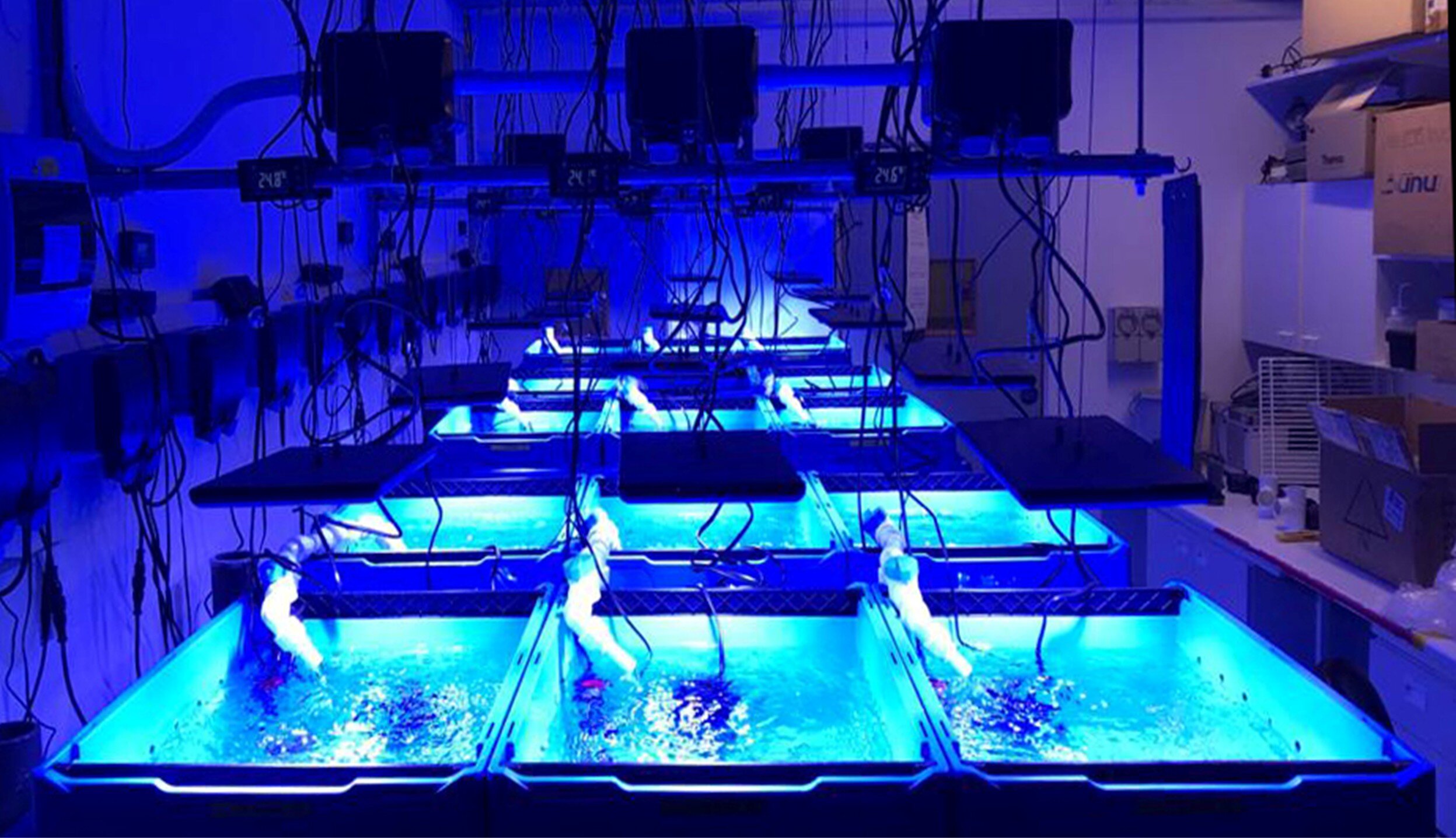
Through controlled laboratory experiments conducted at the Coral Reef Laboratory at the University of Southampton, researchers showed that an imbalance of nitrate and phosphate can lead to the development of disease lesions that are similar to those seen in Black Band Disease.
Crucially, the microbial communities responsible for the disease in the lab not only visually mimic their real-life counterparts found on reefs, but they also include related microbe species that have a similarly harmful impact on corals.
Healthy corals depend on their intricate microbial networks to maintain stability and fend off infections. The study revealed that nutrient imbalances in the seawater disrupt these networks in laboratory corals, diminishing their connectivity and resilience.
As these networks deteriorate, opportunistic microbes, especially dark-coloured, photosynthetic organisms known as “cyanobacteria,” quickly proliferate. These microbes create disease-inducing “microbial mats”—dense, web-like formations that envelop the coral tissue. Secondary pathogens take advantage of this situation and join the disease communities, exacerbating tissue damage and causing the mats to spread over the coral surface.
Dr. Raphaela Gracie from the University of Southampton, a postdoctoral researcher in the team and first author on the paper, explains: “Strikingly, many of the microbes responsible for the disease were already present in healthy coral tissue before symptoms appeared—highlighting that this disease can emerge from within the organism itself, rather than from external infection.”
“Therefore, our research reframes a key coral disease as a micro-ecological imbalance as opposed to a simple pathogenic invasion,” adds Dr. D’Angelo. “This follows similar principles to opportunistic diseases in humans, for instance, fungal infections that follow on from the disturbance of the natural human microbiome by antibiotic treatments.”
To understand the broader relevance of their findings, the researchers analysed global records of BBD outbreaks between 2000 and 2023. They found that over 88% occurred in regions with highly imbalanced nutrient ratios, whereas only 16% were found in reefs that were recently exposed to heat stress.
“Our results show that a vast majority of BBD outbreaks occur in reefs exposed to chronic nutrient imbalance, indicating that water quality management could be a crucial tool for mitigating reef coral diseases in the future,” says Dr. Raphaela Gracie.
However, warming oceans still remain a most severe concern for coral reef survival, as anomalously high temperatures can cause fatal coral bleaching, a major driver of coral reef decline. Furthermore, rising seawater temperatures may shift the nutrient balance in a way that promotes BBD.
Nutrient imbalances can also be caused by human activities including agricultural runoff and wastewater discharge. Reducing such disturbances and managing nutrient levels at a local scale could help to stabilize coral microbiomes and prevent disease.
D’Angelo concludes, “Our results show that it’s not just how much nutrients are in the water, but that the balance between nitrogen and phosphorus needs to be considered as well,” she continues, “Restoring this balance in areas affected by human activities has the potential to reduce disease risk at the local scale.”
[IMAGE: experimental aquarium of the Coral Reef Laboratory at the University of Southampton. Credit: D’Angelo/Wiedenmann/University of Southampton]

