


Latest Shrimpgoby Named For “Sunrise of Java”
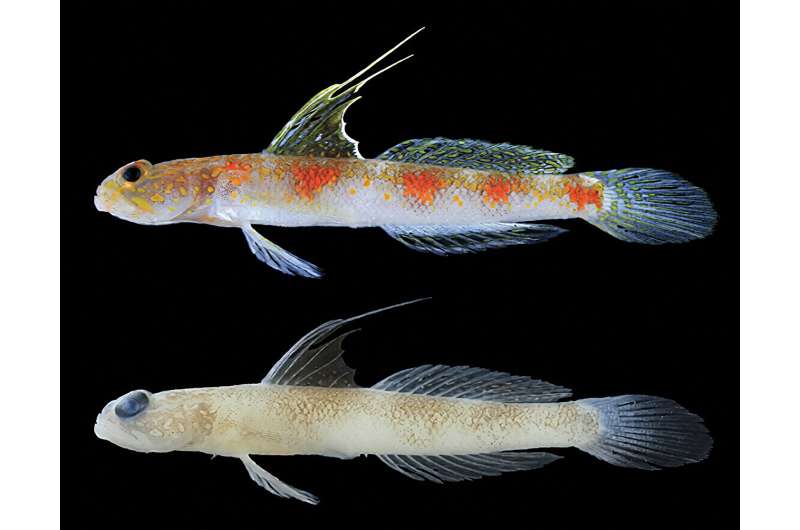
Researchers have identified a new species of shrimpgoby from the coastal waters near Banyuwangi, East Java, and have named it in honour of its vibrant colouration and its place of origin.
In a study published in the open-access journal ZooKeys, a team led by Kunto Wibowo from the Museum Zoologicum Bogoriense, which is part of Indonesia’s National Research and Innovation Agency (BRIN), has formally described Tomiyamichthys oriens sp. nov. This small reef fish is distinguished by its bright orange blotches along its sides and the elegant filaments that extend from the first dorsal fin of the males.
The description is based on two specimens, a male and a female, each measuring approximately 35.5 mm in length. These specimens were initially brought to the researchers’ attention by the ornamental fish exporter CV Cahaya Baru after being collected from the sandy shallows off Banyuwangi. Both specimens are now preserved at the Museum Zoologicum Bogoriense in Bogor.
The name oriens is where this discovery truly shines. It is a Latin participle that translates to “east” or “the rising sun,” chosen for two significant reasons. Firstly, it reflects the fish’s striking orange patterns, reminiscent of a sunrise. Secondly, it pays tribute to the species’ origin: Banyuwangi is located at the easternmost point of Java and is widely recognized in Indonesia as “The Sunrise of Java.” The authors have assigned the common English name Oriens shrimpgoby to this fish.
Tomiyamichthys oriens is a species of shrimp-associated gobies that can be found throughout the tropical Indo-Pacific region, ranging from the Red Sea to Fiji. Its closest relative is T. hyacinthinus, a species that was only recently identified in southern Japan. Both species exhibit a unique combination of traits within their genus: they each have nine segmented rays in their dorsal and anal fins, and males possess two elongated filamentous spines on the first dorsal fin.
However, the Indonesian fish can be differentiated by a variety of subtle characteristics, such as the count of pectoral fin rays, the structure of branched caudal fin rays, the number of longitudinal scale rows, and the configuration of gill rakers, along with more intricate details of its coloration. Genetic analysis of the mitochondrial COI gene further supports its classification as a distinct species, showing a divergence of 3.1% between the Indonesian and Japanese specimens.
This discovery adds to Indonesia’s impressive biodiversity, as it lies at the center of the Coral Triangle and is now home to 13 recognised species of Tomiyamichthys, more than any other nation. Local fishermen involved in the study noted that the new species prefers sandy substrates in shallow coastal waters, although its interaction with the burrowing alpheid shrimps typically linked to this genus has not yet been directly observed in their natural habitat.
With this new description, the total number of valid Tomiyamichthys species worldwide rises to 21, highlighting the vast amount still to be discovered about the small reef fishes that coexist with their shrimp companions in Indonesia’s waters.
“It is always exciting to discover a species that is new to science. We hope this finding will inspire further exploration of Indonesia’s fish biodiversity, where many small and overlooked species are likely still awaiting discovery,” said lead researcher Wibowo.


