


Species Spotlight: The Lavender-Blushed Firefish
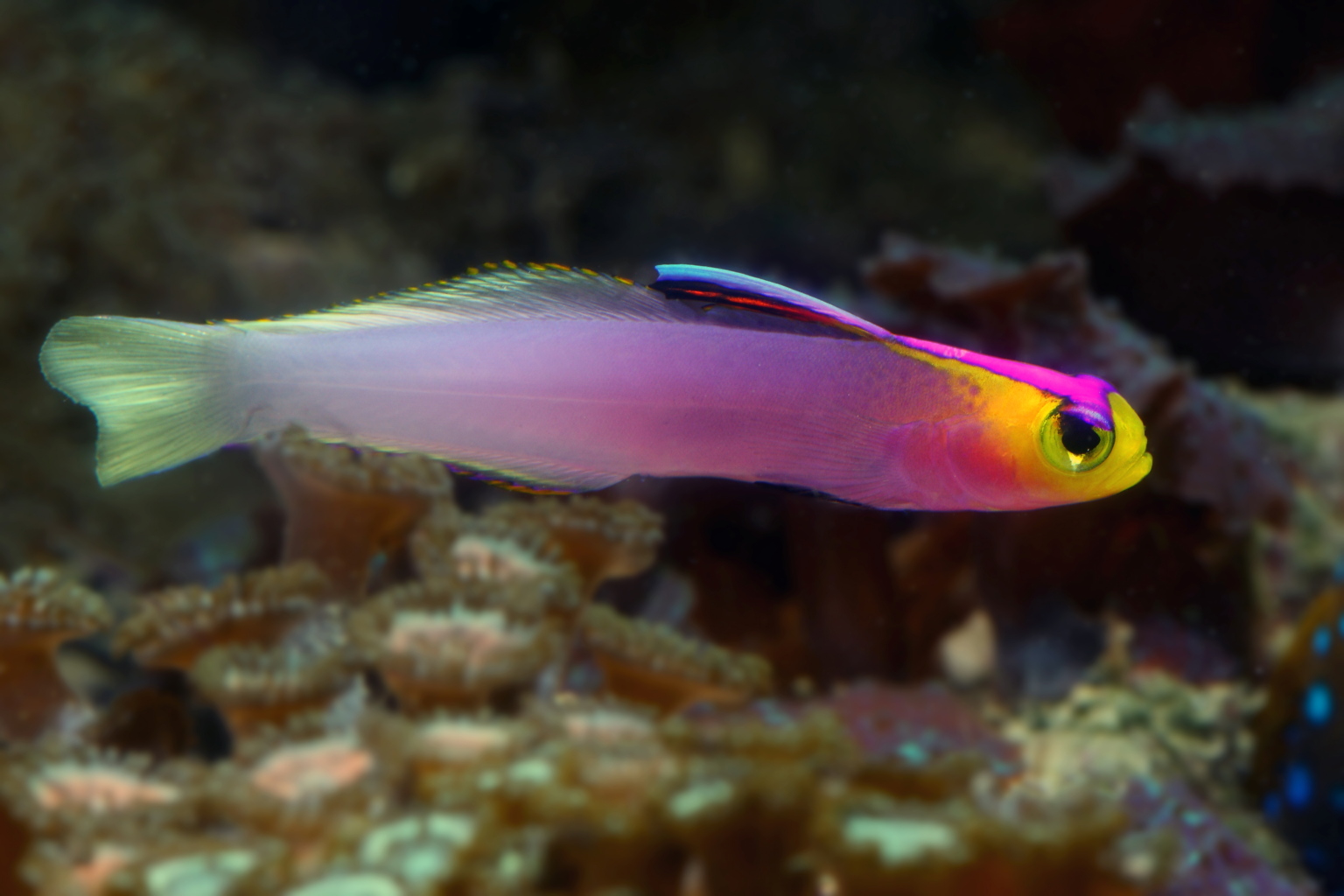
For decades, aquarists and ichthyologists alike lumped a subtly different population of firefish in with Nemateleotris helfrichi, the Helfrich’s or Lavender firefish long-prized in the reef trade. That changed in 2023, when Yi-Kai Tea and Helen Larson formally described Nemateleotris lavandula in the Raffles Bulletin of Zoology, resolving what had essentially been a case of mistaken identity playing out in shops and home tanks worldwide.
Nemateleotris is a small genus within the true goby family Gobiidae, and its members are unmistakable on the reef: small, brightly coloured, elongate fish rarely exceeding 7cm, sporting an elongate pennant-like first dorsal fin that they flick repeatedly, often in sync with their pelvic fins. They typically hover near the substrate on reef slopes and in sand channels at depths of 6-100m, retreating into burrows when threatened.
N. lavandula wasn’t recognised as distinct for so long because the differences, while real, are easy to miss without a side-by-side comparison. The authors found that genetic analysis showed roughly a 1% divergence in sequence data between the two species, alongside consistent differences in body measurements and colouration in both life and preservation.
The two species share a great deal in common — a truncate to weakly emarginate caudal fin, fewer than 10 ctenii on the dorsoposterior scales, a blue anterior edge on the elevated first dorsal fin, pale yellowish-green median fins with yellow or orange spots along the trailing edge of the second dorsal and anal fins, a lavender-to-lilac body, and black-tipped pelvic fins — which is exactly why the two were confused for so long.
The reliable distinguishing feature sits on the face. As lead author Yi-Kai Tea put it, the two differ mainly in the colouring of the head, snout, and upper jaw — helfrichi carries a distinctive black mark on the upper jaw that, combined with its upturned mouth, gives it a moustached look, while lavandula lacks that mark entirely and shows a noticeably yellower head. In practice: check the maxilla. If it’s plain, bright yellow with no dark marking, you’re looking at a lavandula.
The two species are also largely allopatric. N. helfrichi is confined to limited deep-water habitats French Polynesia in the southeastern Pacific, whereas N. lavandula ranges across the western and central Pacific, from southern Japan through the Ryukyu and Ogasawara Islands, south to Taiwan and the northern Philippines, and east across Micronesia including the Caroline, Marshall, and Mariana Islands.
For the aquarium trade, this matters more than taxonomic tidiness might suggest. Given the ranges involved, most “Helfrichi firefish” reaching UK and US shops via Indo-Pacific collection routes are very likely N. lavandula rather than true helfrichi, which comes almost exclusively from the more remote and less commercially fished French Polynesian collection areas. Retailers have been slow to update labelling, so a maxilla check remains the most reliable way to confirm which species is actually in the tank.

[Image: Holotype of Helfrichs’ Dartfish, Nemateleotris helfrichi (BPBM 11595), from Tahiti, Society Islands, April 1971. Source: John E. Randall / FishBase. License: CC by Attribution-NonCommercial]


You must be logged in to post a comment.