


Healthy Corals Help Bleached Neighbours Recover
Healthy corals help bleached neighbours recover
A Stanford study has found that bleached corals can regain their colour simply by touching a healthy colony of the same genetic stock.
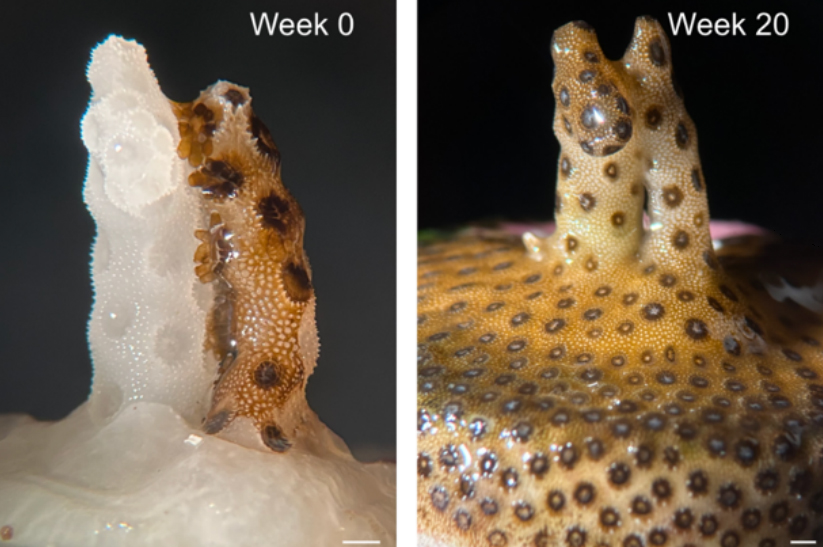
Bleached corals may not be as doomed as we thought. In laboratory experiments at Stanford University, bleached fragments made a full recovery after a few days in direct contact with healthy, well-coloured partners. The results were published this week in Science Advances.
Because so many bleached corals die, researchers have tended to treat them as beyond saving. Lead author Daniel Collins disagrees. He told AFP that bleached colonies “really shouldn’t be thought of as a lost cause”. He also described rushing to his PhD supervisor’s office when the first positive results came in.
How it works
The team worked with pairs of cauliflower coral fragments and informally called the technique “helping hands”. Bleaching happens when heat-stressed corals expel their symbiotic algae. These algae give corals their colour and supply most of their food. The healthy partner restocks the bleached coral with fresh symbionts.
Laser microscopy showed how. Within a day or two of contact, the tissues of the two fragments began to fuse. This created a channel through which symbionts and nutrients could pass from one coral to the other.
The timings were consistent. After three days of contact, the bleached coral began to recover. After five days, it had recovered fully, and the pair could be separated without harm. Contact had to be direct. Fragments placed just a few millimetres apart showed no meaningful change.
Same genet only
There was one important limitation. The method only worked when both fragments came from the same genetic individual, or genet. When the researchers paired fragments from different genets, the corals attacked each other with stinging cells. Collins likened this to organ rejection in humans.
A happy accident
The idea had two origins. One was earlier research showing that plastic debris can spread disease-causing pathogens between corals. Collins wondered whether contact could pass on something beneficial instead. The other was a chance event in the lab. Senior author Stephen Palumbi noticed that a healthy coral and a bleached one had toppled against each other, and the bleached coral had started to recover.
From tank to reef
Using the method on wild reefs is another matter. “We likely will not be touching corals to each other on reefs,” Collins said, because reefs are simply too big. Instead, the team is looking at culturing healthy symbionts and delivering them to bleached corals in large numbers. That approach would also get around the genet problem, because the incompatibility lies with the corals, not the algae.
Reference: Collins et al., Science Advances. doi:10.1126/sciadv.aeh1580

