


Fish Spotlight: Cirrhilabrus aquamarinus — the Chin-strap Fairy Wrasse
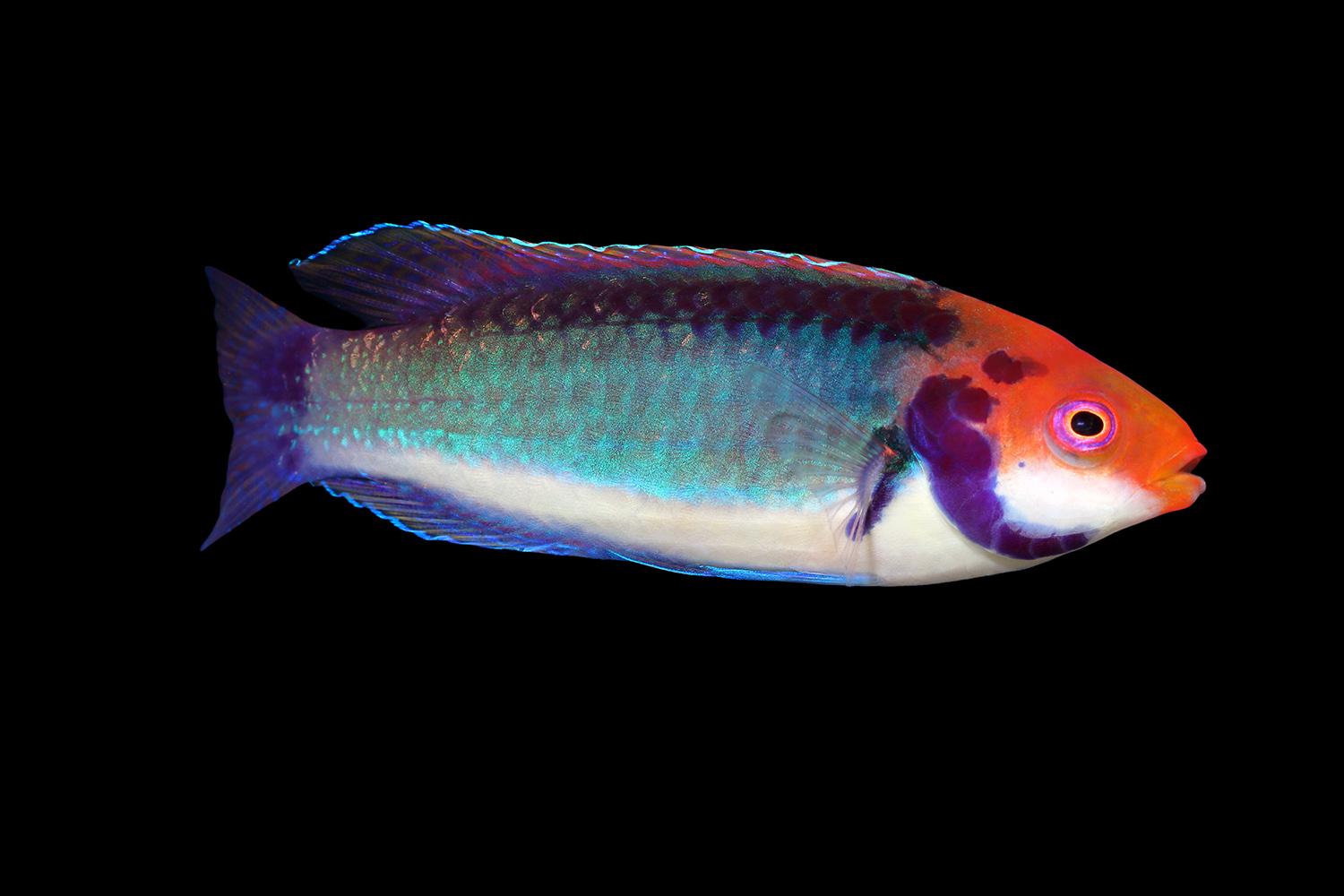
Few fairy wrasses illustrate the messiness of nineteenth-century ichthyology quite as well as this one. For the best part of three decades, the fish now called Cirrhilabrus aquamarinus was traded, photographed and written about under a name that never belonged to it.
That name was Cirrhilabrus solorensis. Bleeker described it in 1853 from material collected at Solor, a small island off the eastern tip of Flores in the Lesser Sundas. The description was adequate by the standards of its day but extremely brief, and the vagueness bred confusion. Over the following century and a half, the name was blanket applied to several visibly different fishes, with terminal males differing most conspicuously of all. Aquarists inherited the mess. Almost any blue-bodied, warm-faced fairy wrasse arriving from Indonesia was labelled “solorensis” with a straight face, and the “red head fairy wrasse” of the trade — a Sulawesi fish — was among them.
The knot was finally untied by Yi-Kai Tea, Gerald Allen and Muhammad Dailami in a 2021 paper in Ichthyology & Herpetology. Working from non-type material and photographic examination of Bleeker’s holotype, they redescribed C. solorensis properly, fixing the name to the Lesser Sunda fish Bleeker actually had in front of him. Two of the imposters were then described as new: C. aquamarinus, on a holotype and eight paratypes from Sulawesi and the neighbouring Banggai and Wakatobi islands, and C. chaliasi, the Ruby-headed Fairy Wrasse, from Bali. The latter honours Vincent Chalias, whose underwater photography and field notes underpinned the work.
The specific epithet is straightforward enough: it refers to the brilliant teal-to-aquamarine cast of terminal males, a colour not matched anywhere else in the genus. The common name comes from a different feature — the heavily pigmented opercular scales, which give males the look of wearing a dark chin strap.
All three species sit within the Cirrhilabrus cyanopleura complex, a group of nine that also takes in C. cyanopleura, C. ryukyuensis, C. luteovittatus, C. randalli and C. aurantidorsalis. They share a weakly rhomboidal caudal fin in males, hyaline median fins with sinuous filigree in both sexes, body scales edged in inky blue to indigo — often in a distinctly argyle pattern — and, curiously, skeletal elements that retain a blue-green tint in alcohol. Colour grades continuously across the complex, which is precisely why the boundaries proved so hard to draw.
In the field, C. aquamarinus is a fish of eastern Sulawesi and the Banggai and Wakatobi groups, with occasional records as far east as Banda Neira. It favours shallow, exposed rubble between five and twenty metres — not the coral-rich slopes some congeners prefer. Its range overlaps marginally with C. chaliasi at Wakatobi, though that appears to be exceptional.
For the aquarist, nothing has changed but the label. This remains a hardy, harem-forming wrasse best introduced females-first, and one of the more reliably available fairy wrasses out of Indonesia (unlike the true C. solorensis which, as we’ve discussed is limited to a small range). What has changed is that we can now say, with confidence, which fish we are actually talking about. On a final note, just be wary of common names applied to this fish too. Out of all species traded, this is one to which I’ve seen some of the most “creative” names applied, with “koi dwarf parrot” or “multicolour solon wrasse” a couple of the most eye-rollingly ridiculous examples.
Interested in more fascinating Fairy Wrasses? The wider Cirrhilabrus genus is covered in UltraMarine issue 120, October 2026!


