


Species Spotlight: McCosker’s Flasher Wrasse
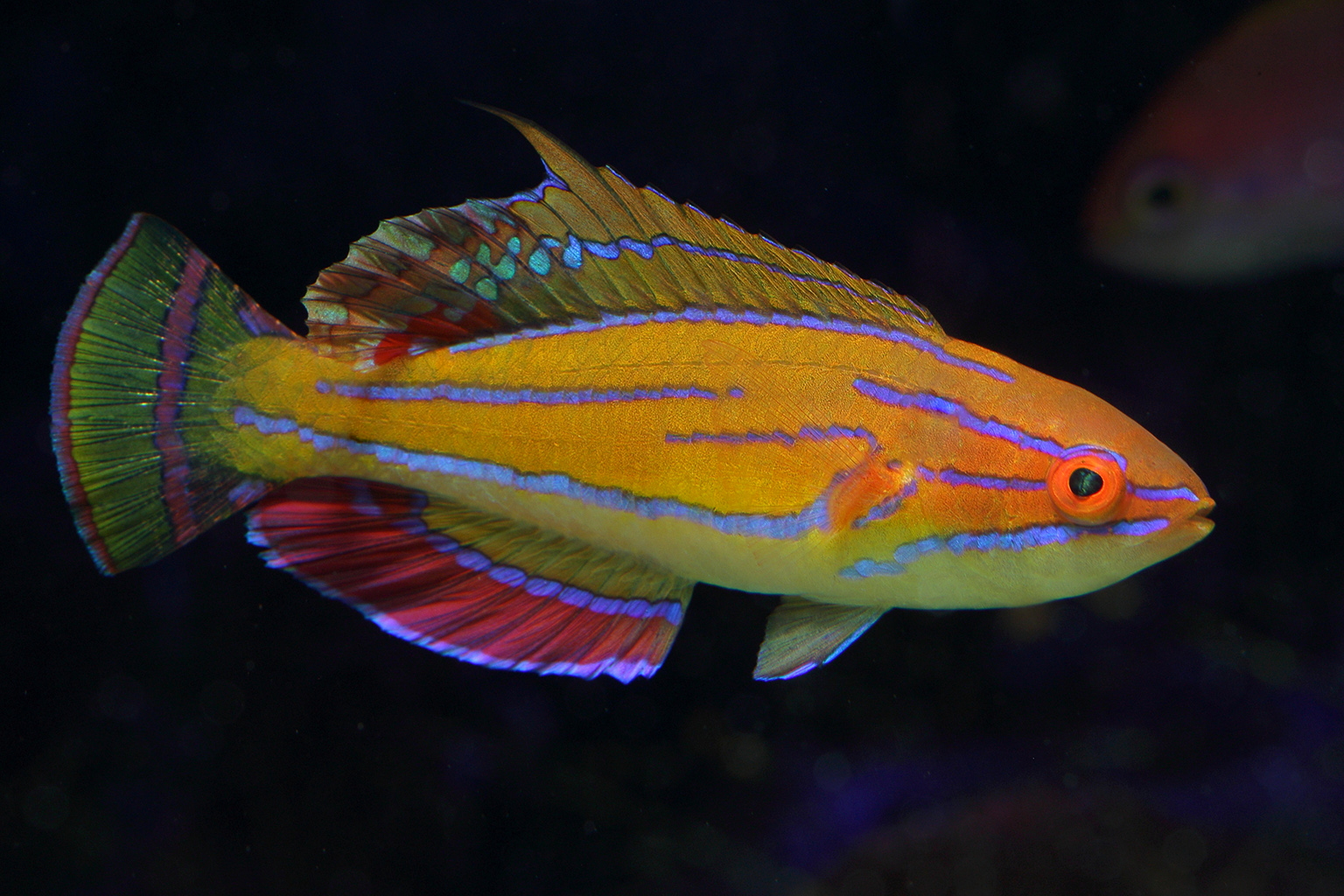
McCosker’s Flasher Wrasse (Paracheilinus mccoskeri) is a vibrant, reef-safe species native to the Indian Ocean. Although fairly common in the trade, It is highly prized for its vivid orange colouration, peaceful nature, and unique “flashing” courtship behaviour. Named after ichthyologist John E. McCosker, this species grows to a maximum length of about 8cm, making it ideal for even modest sized system.
- Geographic Range: Found across the Indo-West Pacific, spanning from East Africa to Thailand, Northern Sumatra, and Fiji.
- Depth & Terrain: Inhabits outer reef slopes, rubble zones, and coral-rich waters at depths between 5 and 40 metres.
- Social Structure: Lives in natural harems consisting of one dominant male and multiple females.
- Note: Unlike some wrasses that bury themselves in the sand, McCosker’s wrasse sleeps in rock crevices wrapped in a protective mucus cocoon that masks its scent from predators.
Appearance and “Flashing” Behaviour
This species exhibits strong sexual dimorphism:
- Males have a brilliant orange/red body, yellow belly, electric blue horizontal stripes, and large decorative fins. They possess a single, distinct elongated ray extending from the dorsal fin, which differentiates them from the very similar Carpenter’s Flasher Wrasse.
- Females display much more subdued, uniform colouration and lack the long, dramatic fin filaments.
- When courting females or displaying dominance to rivals, males may “flash”, rapidly flutter their fins and flaring their colours, causing their neon blue stripes to “flash” intensely.
Tank Requirements & Water Parameters
McCosker’s Flasher Wrasse usually adapts well to captivity if housed in an environment that provides clean, well-oxygenated saltwater. While many keep the species at full salinity (35ppt), it can be housed at slightly reduced salt levels (introducing a fish to a higher salinity is more stressful than the other way around and should be done very carefully). It is important that any tank housing this species should be completely covered to prevent it from jumping.
Dietary and Care Notes
- Diet: Carnivorous planktivores. They require a varied diet of small meaty foods like frozen mysis shrimp, brine shrimp, and high-quality marine flakes or pellets fed multiple times a day.
- Jumping Hazard: This fish is a notorious jumper when startled. A tightly fitting lid or mesh screen cover is compulsory.
- Hermaphroditism: They are protogynous hermaphrodites; all juveniles are born female. If the dominant male dies, the largest female in the tank will change gender to take his place.
Tankmates and Compatibility
- Invertebrates: 100% reef-safe. They ignore corals, clams, crabs, and snails. Avoid large carpet anemones, as the fast-darting wrasse may accidentally swim into them.
- Fish Compatibility: Highly peaceful. They do best with passive tankmates like dartfish, cardinals, and clownfish. Avoid large, aggressive, boisterous fish that will bully them or outcompete them for food.
- Group Dynamic: Keep either a single individual, a solitary male, or a harem of one male with multiple females. Never house multiple males together in a standard tank, as they will fight ruthlessly


