


Hidden Reef ‘Hotspots’ Revealed By Curious Underwater Robot
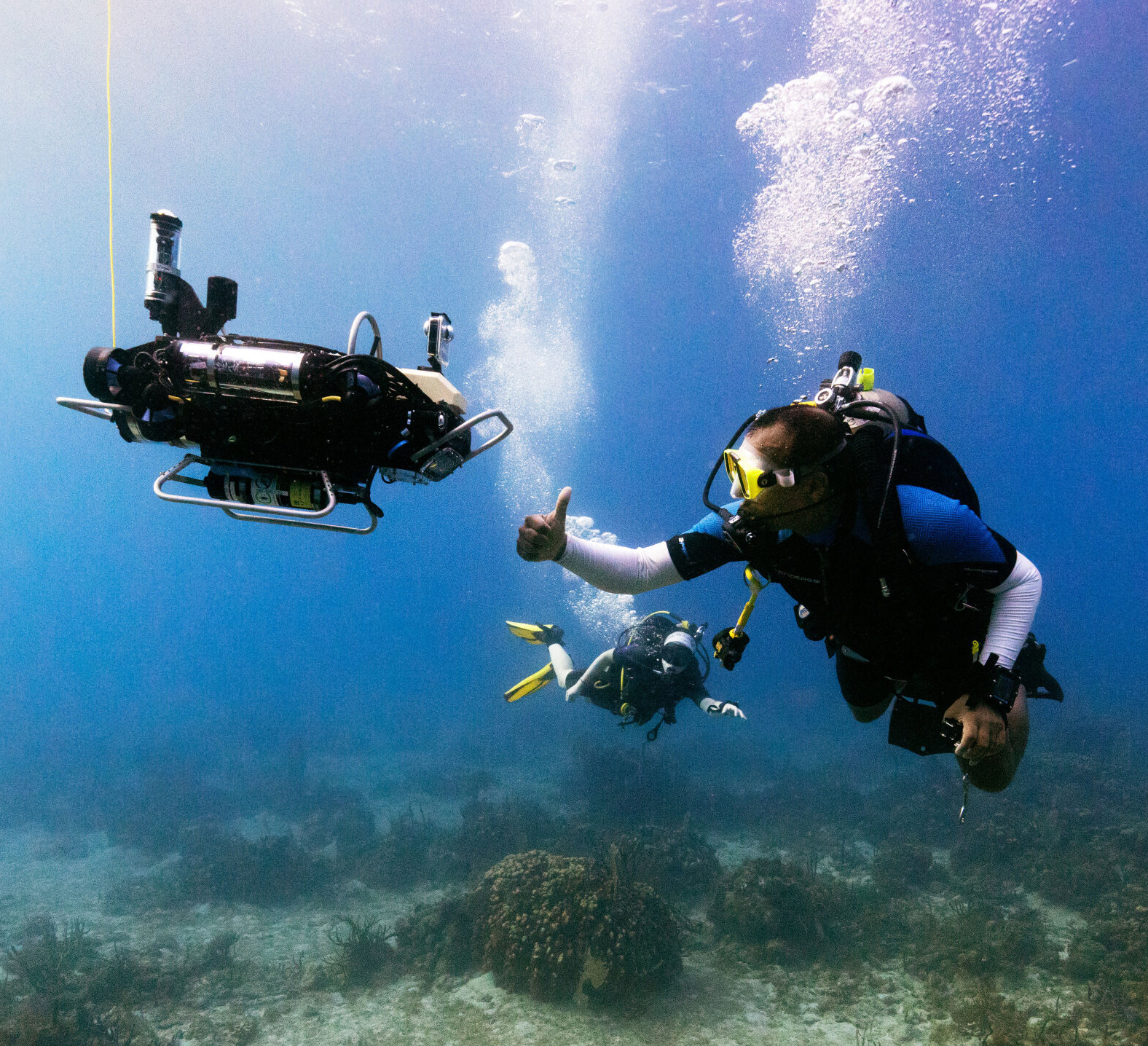
Providing a significant new resource for the study and conservation of some of the ocean’s most precious ecosystems, researchers have created an autonomous system that can locate and map biodiversity hotspots on coral reefs with unmatched accuracy. This research, published in Science Robotics, illustrates how the integration of audio and visual data within a single autonomous system can uncover the concentrations of marine life and the reasons behind them.
The team utilised CUREE (the Curious Underwater Robot for Ecosystem Exploration), a robotic vehicle developed as part of the WHOI Reef Solutions Initiative. By merging CUREE’s cameras, hydrophones, and advanced on-board computers, they were able to analyse audio and visual signals in real-time, allowing the system to autonomously pinpoint areas of heightened biological activity with remarkable resolution.
Their research integrates various observation methods—direct (mapping audio and visual detection of animals) and indirect (inferences drawn from environmental soundscapes or the behaviour of sentinel species)—to determine where biological hotspots are most likely to occur. This system marks a significant advancement in the capacity to identify, map, and monitor the intricate structure of reef biodiversity, which is essential for understanding the health and resilience of reefs.
“We know that biodiversity on reefs isn’t distributed uniformly,” said Seth McCammon, a WHOI roboticist and lead author of the study.
“But until now, we haven’t really been able to reliably quantify that by finding these patchy hotspots, mapping them at the centimeter scale, and measuring just how active they really are. Developing this capability is going to be critical to helping biologists get a deeper understanding of reef ecology moving forward.”
Coral reefs, which make up less than 0.01% of the ocean, yet provide support for about a quarter of all marine species, are facing increasing pressure from rising ocean temperatures, diseases, overfishing, and coastal development. This rich biodiversity is concentrated in specific hotspots—regions of high biological activity that are essential for feeding, shelter, and reproduction.
By analysing biodiversity patterns at sub-meter scales and connecting them to habitat characteristics like reef structure, researchers will gain a clearer understanding of the processes that maintain reef ecosystems. In contrast to traditional reef surveys carried out by trained divers, which can be expensive, limited in scope, and potentially dangerous, CUREE is capable of operating independently for extended periods, accurately positioning itself on the reef, and gathering extensive datasets over larger areas and longer durations.
“That does not mean CUREE is a replacement for human observation of a reef,” said Yogesh Girdhar, the project principal investigator and a roboticist who led the development of CUREE at WHOI’s WARP Lab. “Instead, it’s meant to augment those capabilities and do things a human simply can’t.”
The robot employs an innovative framework that merges various sensing techniques through four complementary behaviours: visual fish surveys, acoustic mapping, sound-guided homing, and the tracking of key “sentinel” species. Collectively, these behaviours enable the system not only to chart areas where biodiversity is abundant but also to actively discover new hotspots—even in uncharted and highly intricate reef environments. During field trials carried out over three expeditions from 2022 to 2024 at a thriving reef in the U.S. Virgin Islands known as Joel’s Shoal, the robot reliably pinpointed the same hotspot: a region surrounding a substantial pillar coral structure. Visual surveys of the reef, named after Joel Llopiz, the WHOI biologist who discovered it and sadly passed away in January, indicated fish densities nearly 25 times greater near this feature compared to the rest of the reef, while acoustic data validated heightened biological activity over a significantly larger area.

The study particularly emphasises the effectiveness of integrating audio and visual data underwater. Passive acoustic sensing can pick up animal activity from tens of metres away—even when creatures are concealed or camouflaged. However, the reef environment is quite noisy, complicating the creation of accurate maps of biological activity using sound alone. Cameras offer detailed, species-specific information, but only over limited distances. By merging these data streams, the robot can detect distant activity through sound and subsequently confirm it with close-range visual observations.
“In some sense, they’re almost a perfect complement for each other,” said McCammon. “Passive acoustics gives you a broad sense of the environment, while vision is short range, but is this really information-rich data stream?” said McCammon.
The system is capable of honing in on particular biological sounds, like the snapping of shrimp or certain fish species that are known for their unique calls. This ability enables it to navigate directly to areas of interest without needing any prior knowledge of the reef. In controlled experiments, the robot effectively tracked sound sources from distances reaching up to 80 metres and autonomously converged on natural reef hotspots from as far as 30 metres. In another demonstration, the robot trailed a barracuda—a key predator essential for the health of the reef ecosystem—as it navigated through its habitat to pinpoint a hotspot. Researchers suggest that this method of autonomously observing where the sentinel species frequently returns could serve as an additional means to identify ecologically significant locations, providing valuable insights into predator interactions with their environment.
Ultimately, the researchers foresee deploying fleets of such robots worldwide to explore and monitor reefs that are still largely uncharted. By swiftly locating and characterising biodiversity hotspots, this technology could assist in guiding conservation decisions, prioritizing protection efforts, and tracking changes in ecosystems within a warming ocean.
“As coral reefs face unprecedented challenges, we need smarter, faster ways to understand where life persists and why, so conservationists and resource managers can focus their attention where it’s needed most,” said Girdhar. “Autonomous systems like this can help us find—and protect—the most vital parts of these ecosystems before it’s too late.”
[main image: Woods Hole Oceanographic Institution]


